The Eye as a Map of the Underworld
Initial Observation: February 21, 2026 — Pattern Recognition between the iris and the satellite system of Pluto.
The eye has long been regarded as a window to the soul, an idea immortalized by Shakespeare. But perhaps it is also a map of the Underworld, a type of planisphere. And within its rings lies a forgotten geography: where the boundaries between heaven, myth, and flesh quietly dissolve. In this way, the iris becomes less an organ than a landscape, where mythology and anatomy begin speaking the same language. This is an exploration of that language—of the correspondences between the rivers of the underworld, the moons of Pluto, and the architecture of the human eye.
Scientific observation has identified five moons circling Pluto. In order, they have been named Charon, Styx, Nix, Kerberos, and Hydra. Among the archetypal planets possessing lunar bodies, this is a rare and modest number. Yet their orbits are strikingly ordered, forming concentric circles that suggest an underlying geometry.
Charon circles nearest Pluto, orbiting a barycenter, followed by a significant empty stretch — before Styx and Nix, which orbit close together. Another shorter gap separates them from Kerberos and Hydra, which form a tight pair at the outer edge.
When I first saw a diagram of this lunar arrangement, its shape was immediately familiar. The structure did not simply look astronomical — it looked anatomical. The moons were arranged to radiate outward in much the same way as the iris of the human eye.
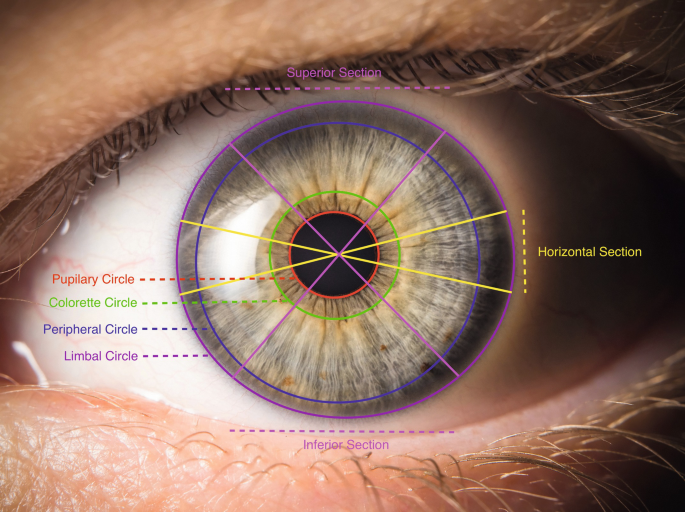
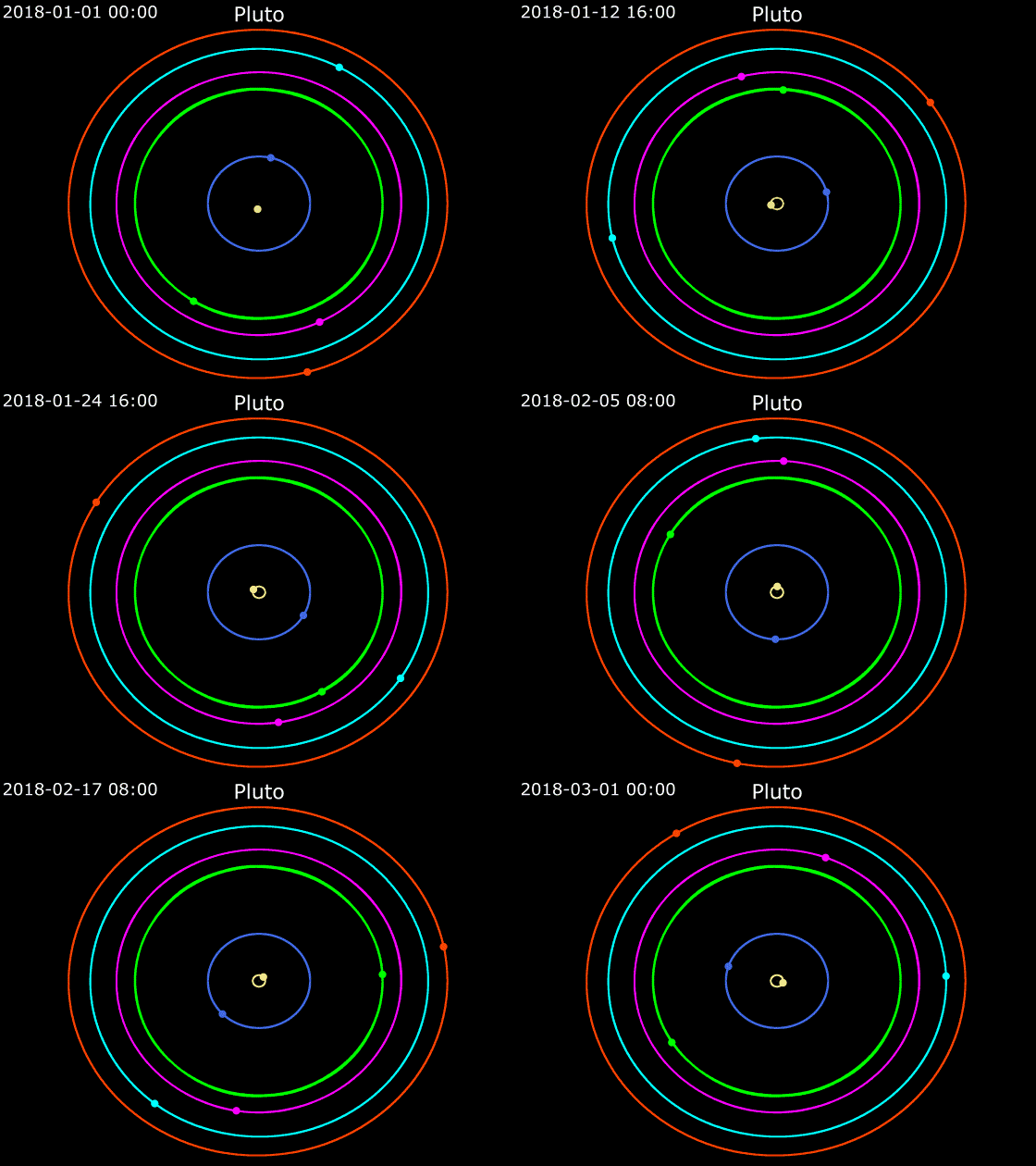
Left, diagram of Iris Anatomy by Springer Nature. Right, animation of Pluto and its lunar orbit system created with the JPL Horizons Solar System Data and Ephemeris. These diagrams are visual comparisons of the human iris and the lunar orbits of Pluto. They are presented for educational purposes. Click any diagram to enlarge it.
This observation led to a simple question: could the lunar system of Pluto compare mathematically to the rings of the iris? Could this be the same pattern seen on a cosmic scale?
The comparison also invites a mythological perspective. Classical sources describe the underworld as encircled by five mythological rivers: Acheron, Phlegethon, Cocytus, Styx, and Lethe. Each lunar orbit may correspond symbolically to one of these rivers, mirroring the ancient geography of the underworld — a pattern reflected in the eye, long believed to be a window into the soul.
What follows explores each moon in relation to one of these rivers, along with a comparison of their orbits to the concentric patterns of the human iris.
Visual Comparison
The five moons orbiting Pluto occupy progressively wider orbital distances. When their distances are scaled proportionally, the pattern mirrors how the human iris is described in anatomy, called the five-layer radial structure.
Pupil – the central opening of the eye that regulates the light entering the retina
Pupillary Circle – the protective boundary surrounding the pupil
Collarette – the thickest structural ridge of the iris separating the inner pupillary zone from the outer ciliary zone
Peripheral Circle – the outer structural fibers of the iris and inner boundary of the limbal zone
Limbal Ring – the dark outer border where the iris meets the sclera
Configurations of Hydra, Nix, and Styx over one quarter of the cycle of their mutual orbital resonance, revealing an even more striking parallel to the iris.
Mathematical comparison
To compare the spacing of these two systems, both must first be placed on the same scale. The distances of the moons orbiting Pluto are usually given in kilometers, while the rings of the iris are usually measured in millimeters. To make a direct comparison possible, each system will be normalized so that its outer boundary equals 1.00.
In the Pluto system, the orbit of its furthest moon—Hydra—serves as the outer reference point. In the eye, the outer edge of the iris—the limbal ring—serves the same role.
Once both systems are scaled in this way, their radial spacing can be compared directly.
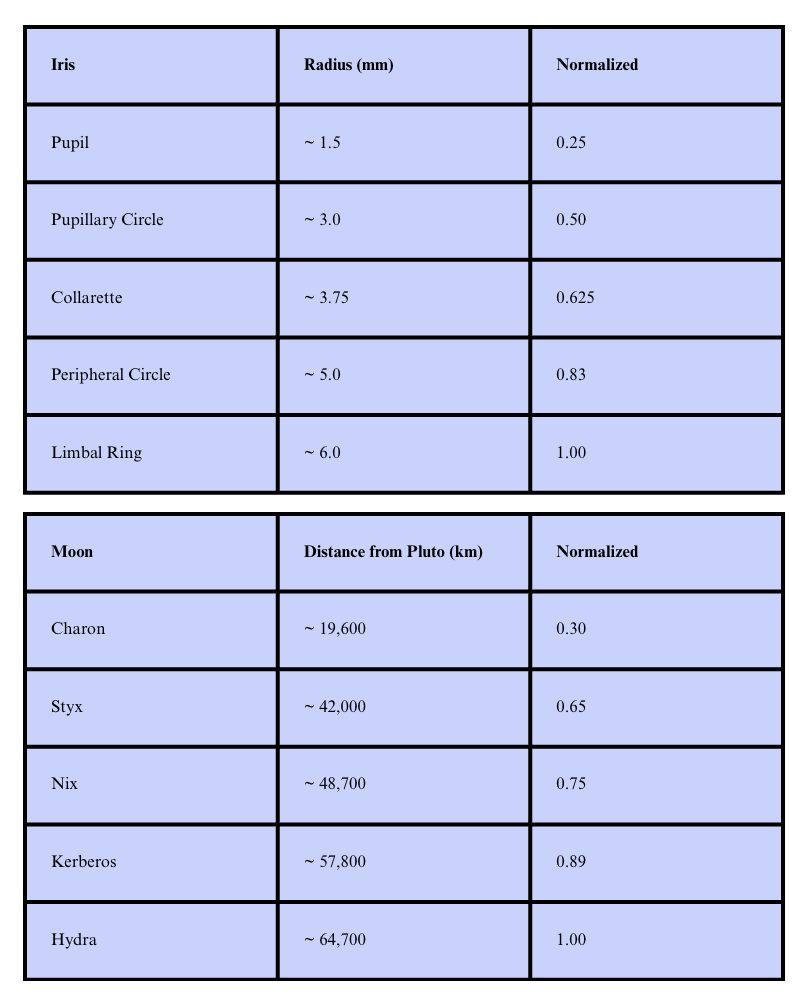
When plotted together, the two systems display a strikingly similar distribution pattern. In both cases the majority of structural complexity occurs toward the center, followed by a transitional middle region and a compressed outer boundary.
In the eye, this pattern corresponds to the pupil, pupillary margin, and collarette before transitioning outward to the peripheral iris and limbal ring. In Pluto’s lunar system, the same structure appears in the arrangement of Charon near the barycenter, the intermediate spacing of Styx and Nix, and the tightly paired outer orbits of Kerberos and Hydra.
The outermost band in both systems occupies roughly 11–17% of the total radius, producing a similar compression of the outer ring. When normalized in this way, the maximum deviation between the two systems is approximately ±0.15 of total radius, well within the range expected from natural biological variation.
The comparison therefore suggests that the structural distribution of Pluto’s moons follows a radial pattern remarkably similar to that observed in the concentric anatomy of the human iris.
Appendix I — Anatomical Sources
The diameter averages used in this study were collected from multiple anatomical references, including The Iris: Understanding the Essentials by Kambiz Thomas Moazed, ScienceDirect: Pupil Size and Retinal Illumination, and IntechOpen: Iris. For each structure, reported ranges were compiled and the median value was selected as representative for normalization. Average iris diameters were derived directly from these sources.
For the pupil, bright-light measurements were used to define the central opening, while the pupillary margin was defined using average dark-light pupil sizes, obtained from Clinical Methods: The History, Physical, and Laboratory Examinations, Chapter 58 “The Pupils” by Robert H. Spector. The collarette diameter was calculated based on its distance from the pupillary margin as reported in the same sources.
Appendix II — Astronomical Sources
The radial distances of Pluto’s satellites from the center of Pluto were collected from multiple authoritative references, including Encyclopedia Britannica and NASA Science. For each satellite, reported ranges were compiled, and the median value was selected as the representative distance for normalization.
All measurements were normalized to Pluto’s maximum radius to produce a relative scale from 0 to 1 based on the outermost moon. This approach allows direct comparison of the Pluto satellite system to the iris system while maintaining proportional consistency. Differences between normalized values were calculated to assess relative spacing across the system, with deviations falling within the expected range of observational uncertainty.
Circle i
The River of Torment
Unlike most Planet–Moon systems, where the moon orbits the planet, Pluto and his closest lunar body orbit a point between them: known as the barycenter. This unusual arrangement creates a void, a shared center of mass that is neither planet nor moon.
In the eye, this void is mirrored by the pupil. Like the space between Pluto and Charon, it is central and receptive—the gateway through which light and perception, enters—the junction where what is visible meets what lies beneath, where inner and outer realities converge.
The river most closely associated with Charon is Acheron. Most classical sources present Acheron as the entrance to the Underworld, where Charon ferries souls of the dead. Pindar, Aeschylus, Euripides, Plato, Callimachus, and Pausanias all place Charon performing his duty upon its waters. In Dante’s Inferno, the river forms the border of Hell: Charon ferries the newly deceased sinners across, while those who were neutral in life remain on its shores.
Plato echoes this narrative in The Phaedo, describing Acheron as “the lake to the shores of which the souls of the many go when they are dead". The Suda, a 10th century Byzantine encyclopedia, describes the river as "a place of healing, not a place of punishment, cleansing and purging the sins of humans".
The etymology of the name Acheron further enforces its symbolic selection as the river of the first Moon, as the term is occasionally used as a synecdoche for Hades—the Underworld—itself. This mirrors the way Pluto and its closest moon orbit a shared barycenter, a celestial arrangement that has led some in the scientific community to consider reclassifying Pluto as a binary-planet system.
Virgil once wrote about Acheron, “If I cannot bend the will of Heaven, I shall move Hell,” a line later used by Sigmund Freud as the opening epigraph for The Interpretation of Dreams. In using this quote, scholars note that Freud interpreted Acheron as “the psychological underworld beneath the conscious mind,” an idea echoed in the pupil as the portal through which awareness receives the world, where light and perception converge upon the deeper, unseen layers of the psyche. This suggests that Freud may have, perhaps unconsciously, tapped into an archetypal insight — that the underworld exists beneath the aperture of sight.
It is often said that, at the moment of death, one’s life flashes before their eyes. In this vision, the pupil is not merely a gateway into the world—but also into the underworld—as a threshold through which the soul passes.
Another age-old adage reminds us that “ignorance is bliss”. If bliss belongs to those who remain unconscious, then consciousness—the act of perceiving—may carry with it the burden of torment. In this sense, Acheron’s designation as the “River of Torment” could illustrate this transition from unknowing into awareness, from life to death, or even from death to birth, decoding observations described in Stanislav Grof’s Basic Perinatal Matrices regarding the profound psychological experiences of these liminal moments.
Circle II
The River of Oaths
Unlike the other rivers of the Underworld, the Styx occupies a unique position in Greek cosmology. Often described as the boundary between the mortal world and the realm of the dead, it is the river across which the souls of the departed must pass, and the sacred water by which the gods themselves swear their most binding oaths.
Hesiod, in Theogony, describes Styx, the goddess, as the foremost among the daughters of Oceanus, whose waters possess such divine authority that even the Olympians are compelled to honor vows made in her name.
The river’s role as a cosmic boundary makes it a fitting successor to Acheron in the sequence of Pluto’s moons. While Acheron marks the entryway to the Underworld, Styx represents the dividing line itself—the threshold separating one state of existence from another. In many classical accounts, the river is said to encircle the Underworld nine times, symbolizing numerically the idea of completion and finality that accompanies passage between realms.
It is therefore notable that the second moon of Pluto takes the name Styx. Among the rivers of the Underworld, Styx remains perhaps the most widely recognized in the modern imagination, the name most likely to be known even by those only casually familiar with Greek mythology.
Rather than coincidence, this prominence may reflect the role of the river within the mythic geography of the afterlife. In many traditions Styx functions as both the river of divine oaths and the boundary separating the mortal world from the realm of the dead. If the geography of the Underworld preserves symbolic memory of the passage of the soul between realms, Styx would represent one of the few stages encountered universally.
Within this framework, the persistence of the name may point toward a deeper principle in the naming of celestial bodies. Certain symbols exert greater influence upon the collective imagination when they correspond to experiences shared by all souls. Even when such experiences are forgotten in waking life, their imprint may remain within the subconscious. In this sense, Styx, the river of binding oaths and passage between worlds, carries a particularly strong symbolic resonance, making it one of the mythic names most likely to emerge intact within the symbolic ordering of the Pluto system.
This symbolism finds a compelling analogue within the structure of the eye. If the pupil serves as the gateway through which light and perception enter, then the pupillary circle forms the boundary that defines and encircles that aperture. Like the river Styx, it marks the precise point at which one domain gives way to another: the luminous opening of the pupil and the surrounding field of the iris.
The myth of the sea-nymph Thetis and her son Achilles offers an additional layer to the literature on this river. According to tradition, Thetis carried the infant Achilles to the waters of the Styx and immersed him in its current in an attempt to grant him immortality. The story suggests that the river occupies a liminal position within the cosmology of the Underworld—close enough to the boundary between realms that a living mother could reach it, yet powerful enough to alter the conditions of mortal existence.
In this light, the Styx represents more than a simple border. As the river by which the gods swear their oaths, it embodies the modern idea of the spiritual contract—an irreversible agreement that governs the passage between states of being and the course of life. The pupillary circle reflects this same principle. Encircling the aperture through which perception enters the body, it may be understood symbolically as the ring that seals the pact of incarnation: the boundary through which the animating soul passes into the visible world.
Within this framework, the waters of Styx may be understood as the place where such oaths are sworn before the soul enters life, and where they are recalled once that life has ended. Just as the gods are bound by vows made upon the river, so too may souls enter the world through a covenant of experience—a promise that precedes incarnation and animates the pupil with the light of perception.
Circle III
The River of Blood
The third moon of Pluto is named Nix, derived from the primordial goddess of Night. Scholars of the earliest known Orphic cosmogonies believe that Nix was considered to be the first deity.
According to Virgil and Hesiod, Nix dwells within Tartarus—the deepest and darkest region of the Underworld. There, at what Hesiod calls the “great bronze threshold,” she inhabits a “Mansion of Night” “wrapped in dark clouds,”—during the cycle of day and night when it is her time to rest.
Across ancient traditions, Nix and Tartarus appear repeatedly in close association, sometimes described as siblings, sometimes as progeny, and at other times as primordial companions.
The most widely known interpretation presents them as primordial siblings born directly from Chaos. Yet alternative cosmologies preserve different relationships. The Neoplatonist philosopher Damascius records a tradition in which Aether and Nix birth Tartarus, who in turn produces two Titans with Nix.
For the purposes of this cosmology, the most intriguing interpretation appears in De Pietate, preserved through Philodemus and attributed to the legendary poet Musaeus. In this account, Nix and Tartarus form the first pair of beings to exist, from whom “all things are born.”
In Greek mythology, the river Phlegethon is a boundary encircling Tartarus, forming a fiery moat around the deepest prison of the damned. In Dante’s Inferno, Phlegethon is “a river of blood coursing restlessly” where the violent are submerged to boil for their sins—at the threshold of Hell.
“By causing hot blood to flow through their violent deeds in life, they are now sunk in the flowing, boiling blood of the Phlegethon.”
When Aeneas descends into the Underworld in the Aeneid, Virgil describes the infernal landscape with striking imagery:
“With treble walls, which Phlegethon surrounds,
Whose fiery flood the burning empire bounds.”
In the original Latin, “treble walls” appears as “triplici muro,” describing Phlegethon as a triple defensive barrier before the infernal region of Tartarus — a phrase aligning this river with the third lunar orbit of Pluto through the universal language of number.
Within the eye, this orbit is mirrored by the collarette, the thickest and most structurally pronounced region of the iris. The collarette forms a raised circular ridge that separates the iris into two primary divisions: the pupillary zone, which surrounds the pupil, and the outer ciliary zone, which occupies the remaining expanse of the iris. This makes it the strongest barrier within the iris.
Running through this ridge is the arterial circle, a circular network of blood vessels that distributes blood throughout the iris. Because of the blood vessels concentrated within the collarette, this region often appears particularly vivid, with pigments that produce rings of amber, bronze, or copper within the eye — recalling the “wall of bronze” from Hesiod’s Theogony above.
The anatomical structure therefore mirrors the ancient imagery of Phlegethon with striking precision. As the arterial circle courses through the collarette, the eye contains a literal river of circulating blood, forming a boundary within the iris much like the fiery river that surrounds the infernal realm.
Emotion and physiology deepen this parallel. Muscles within the iris contract and expand to regulate the pupil’s aperture, controlling how much light passes into the darkness of the pupil. The collarette lies at the center of this mechanism, marking the domain of ‘the goddess of Night’.
The iris is also richly vascularized. States of intense emotional arousal—rage, stress, fear, or desire—can increase blood flow to the ocular tissues. In such moments, the eye itself can visibly redden as vessels fill and expand. The metaphor from Inferno of Phlegethon as a river of boiling blood therefore finds an unexpected resonance in the living dynamics of the eye.
Seen through this lens, the collarette becomes an anatomical counterpart to Phlegethon: a circular boundary within the iris defined by its arterial network, where a living ring of blood surrounds the pupil like a fiery river encircling the threshold of the underworld, separating it from the deepest realm below.
Circle IV
The River of Lamentation
The fourth moon of Pluto is named Kerberos. It shares a linguistic resonance with Cocytus, illustrating how archetypal insights embedded in the collective psyche can be transposed into the naming of celestial bodies.
In Dante’s Inferno, Cocytus is depicted as a frozen lake, the lowest circle of Hell, where traitors are buried in ice according to the severity of their treachery. By nature, this frosty exterior must encase a river of liquid.
Anatomically, this aligns with the outer ciliary zone of the iris, ending at the peripheral circle—or the fourth lunar orbit. Beneath this zone, the ciliary body produces aqueous humor, which maintains the pressure and shape of the eye. This hidden reservoir beneath the ciliary zone mirrors Cocytus, as ice also utilizes pressure and confinement to immobilize treacherous souls within the pages of Dante’s Inferno.
The naming of this moon as Kerberos evokes the three-headed hound who is said to guard the gates of the Underworld. A similar triadic structure appears in the movement of the aqueous humor. While produced in the posterior chamber, the fluid then passes through the pupil—the entrance into the Underworld—and into the anterior chamber before draining at the angle where the iris meets the cornea. These three sequential regions regulate the movement and containment of the fluid that maintains ocular pressure, forming a triadic system of passage and restraint reminiscent of the three heads of Kerberos.
Circle V
The River of Forgetfulness
The final moon of Pluto is named Hydra, anatomically corresponding to the outer edge of the iris, the limbal ring.
In Greek mythology, the Hydra is a multi-headed aquatic monster, most famously associated with the lake of Lerna. Its connection to Lethe—the last remaining river of the Underworld—is less immediately obvious than other moon–river pairings, which may explain why its name initially seems discordant. Lethe, after all, is the river of forgetting.
The link becomes clearer when we consider that the Hydra was said to dwell near an entrance to the Underworld. Some scholars also associate it with branching rivers, reflecting both its multiple heads and the trial-and-error nature of ancient river dam constructions: when one head was severed, two new streams would emerge. Even the name “Lerna” echoes Lethe through its shared initial letters, subtly tying the monster to the mythic river of forgetfulness.
The Hydra’s regenerative nature further deepens this association. Each severed head grows anew, discarding the old and creating something seemingly forgotten. Similarly, Lethe washes away memory. Anatomically, the limbal ring fades with age, often accompanying cognitive decline and forgetfulness. As we grow older and more susceptible to memory loss—Alzheimer’s or dementia—we may display a range of unexpected expressions or emotions seeming to multiply across our faces: an echo of the Hydra’s many heads.
The limbal boundary also marks the edge of visual perception. Beyond this point the eye no longer gathers structured information from the world. The outermost ring of the iris therefore occupies a liminal threshold between sight and blindness, between perception and oblivion. This boundary mirrors Lethe’s role within the underworld: the final river where memory dissolves and consciousness fades into forgetfulness.
The Eye as a Map of the Underworld?
Across myth, anatomy, and astronomy, the same circular architecture appears again and again: concentric circles radiating outward from a central void. In the heavens, Pluto and its five moons trace this geometry through orbital motion. In the human body, the eye reveals it through the rings of the iris. In ancient mythology, it appears as rivers encircling the Underworld.
Although mathematical parallels have been drawn between large-scale cosmic structures and complex anatomical networks — such as the comparison of the brain and the cosmic web explored by Franco Vazza and Alberto Feletti in Frontiers in Physics—no prior study has aligned a specific human body part with a particular celestial system.
The origin of these correlations—whether chance, archetype, or deeper natural law—remains uncertain. One point, however, is clear. This analysis identifies the first quantifiable alignment of body and cosmos for a defined anatomical and celestial pair. That correspondance appears in the satellite system of Pluto—a celestial body with archetypal associations of hidden treasure, transformation, and generational change.
About the Author
Kalyn Lady has the planet Pluto at 29° of Scorpio in tropical— the anaretic “Degree of Fate” in its own rulership.
