The Synastry of Walt Disney and Kalyn Lady
The Immaculate Conception
The Florida Project is considered the most elaborate vision undertaken by Walt Disney: a vast experiment encompassing theme parks, an experimental city, new systems of transportation, architecture, technology, community, and a radically different vision for how people might live. It wasn't simply another theme park. Nearly every element was planned as part of a much larger environment. Walt Disney was attempting to create an entire world.
And it was here, within this world, that I was conceived.
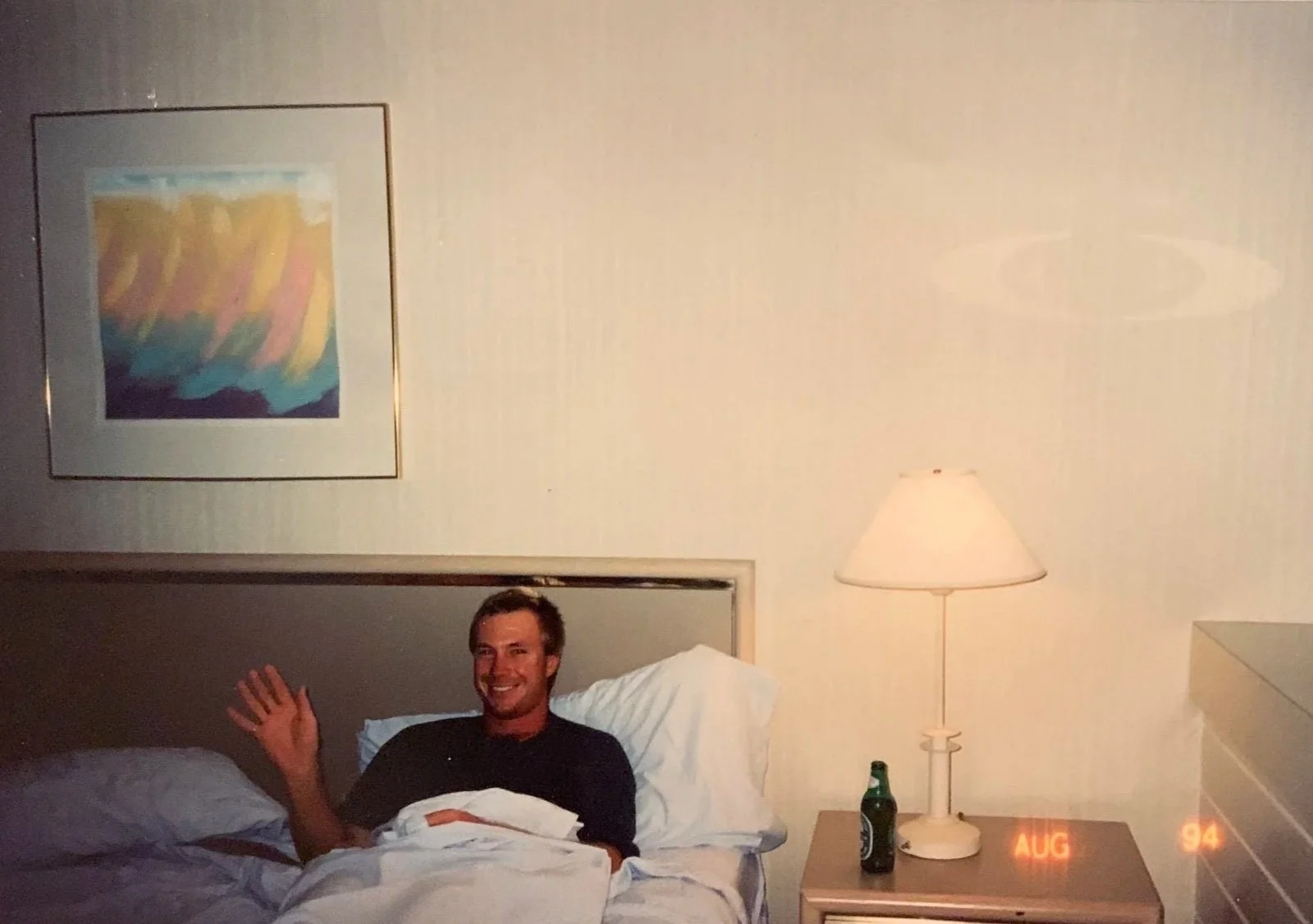
It was August 1994, and my parents had just spent the entire day at the Magic Kingdom of Walt Disney World, whose official slogan at the time was “Where Dreams Come True™.”
I had always heard that I was conceived at Disney World. As if to confirm the story, my mother took a photograph of my father waving from beyond the grave inside their hotel room right before it happened. It is dated exactly nine months before my birth in May of 1995.
There is an old myth about a sculptor named Pygmalion who became so devoted to his creation that he carved himself the perfect woman from ivory. He named her Galatea. Then, through divine intervention, she came to life.
I sometimes think of that story when I consider the circumstances of my own beginning.
Walt Disney spent the final years of his life attempting to create a world unlike any that had existed before, yet he died before the Florida Project was completed.
One revolution of Saturn later, I was conceived inside it.
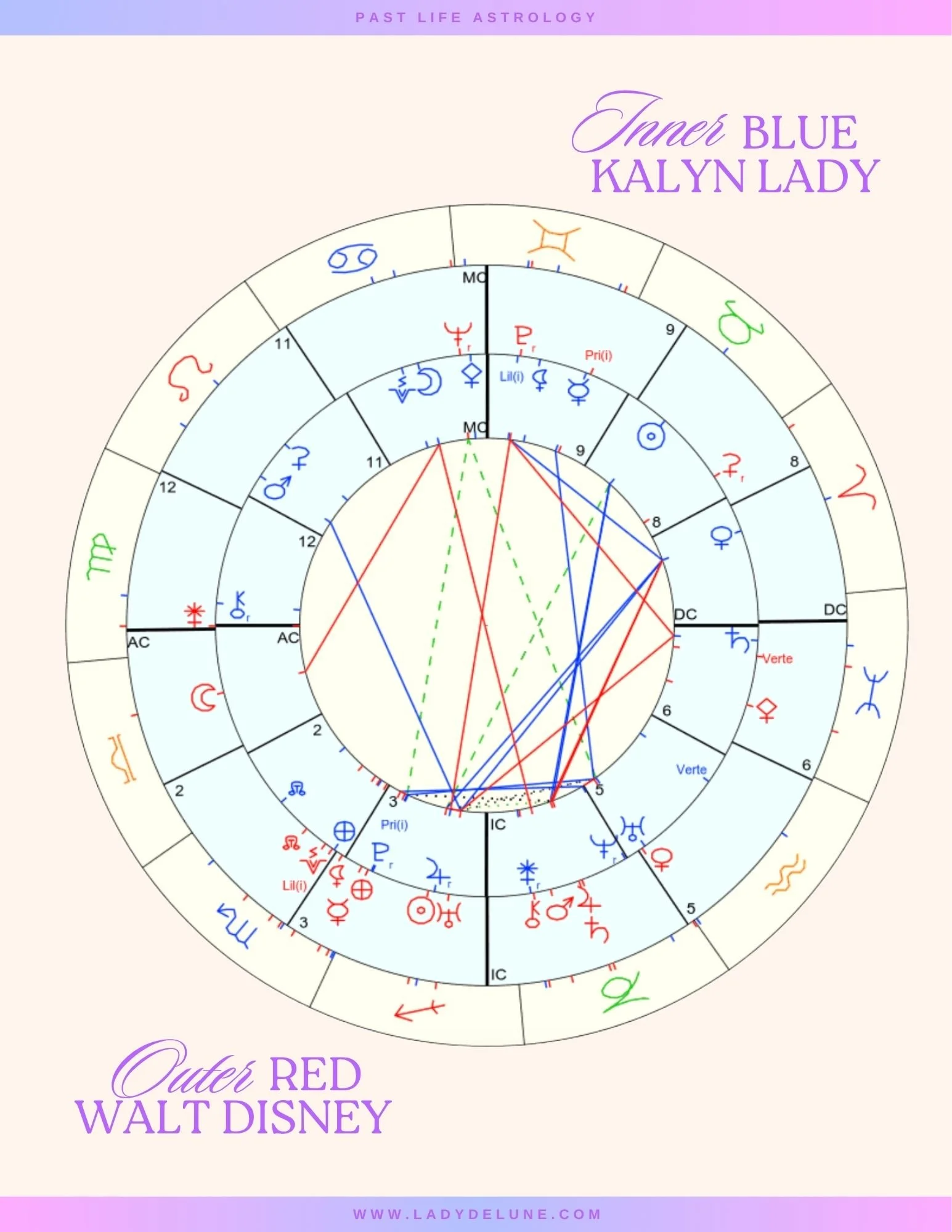
The first thing that caught my attention in our synastry was not a planet. It was the four most important points in a chart: the Ascendant, Descendant, Midheaven, and Imum Coeli.
Together, these angles form the Cross of Matter— the points through which the intangible becomes tangible and life takes form.
In simpler terms, they describe how you are perceived by the world, the relationships you form, the foundations you build from, and what you become known for.
Walt Disney / Kalyn Lady
asc / ASC — 0°
dsc / dsc — 0°
mc / mc — 0°
ic / ic — 0°
Four exact points are enough to make the resemblance difficult to dismiss as poetic coincidence. Somehow, the man who spent his life giving form to an imagined world and the woman who came into being inside it were given the same coordinates. Whatever else our charts may say, the sculptor and the sculpture seem to emerge from the same frame.
If the four angles describe the structure through which a person takes form, the next pattern I noticed was one that past-life astrologers consider especially significant.
Walt Disney / Kalyn Lady
south Node / sun — 0°
sun / jupiter — 0°
Jeffrey Wolf Green, one of the foremost astrologers of Evolutionary Astrology, has noted that “there is often a Sun–Node connection between one’s present and past life charts.” Dunnea Rae also explicitly lists “one person’s Planet or Vertex conjunct the other’s North or South Node” as her #1 past-life synastry sign.
The Sun represents the self, the soul, and the central identity, while the South Node represents what has already been lived—the experiences, patterns, attachments, and gifts carried forward from somewhere else. My Sun conjunct his South Node therefore places my identity directly in contact with what he has already lived.
But the symbolism does not stop there. His Sun is also conjunct my Jupiter. Jupiter is a planet of expansion, abundance, and possibility; traditionally considered lucky, it is also associated with the archetypes of the king, the husband, and the guru. Beyond his South Node activating my soul, his soul is conjunct my Jupiter. The first contact points backward, into the territory of memory, inheritance, and what has already been learned. The second points outward, toward expansion, possibility, and a world becoming larger than the one that existed before.
Mirrored Aspects
One thing I have noticed repeatedly in the synastry charts that interest me most is the presence of mirrored aspects. By mirrored, I mean a reciprocal connection in which the same two planets or points aspect one another in both directions between two charts.
Walt Disney and I share more mirrored aspects than any synastry chart I have ever encountered—except for the one between myself and the person I suspect may be my Prince Charming.
Walt Disney / Kalyn Lady
Juno / ASC — 0°
Chiron / Juno — 0°
Juno / Chiron — 4°
ASC / Chiron — 4°
IC / JUNO — 8°
Chiron / IC — 9°
His Juno sits directly between his Ascendant and mine.
Juno is the sacred vow, the promises we make, and the relationships that become binding, while the Ascendant is the point of identity and incarnation—the sign rising on the horizon at the moment a person enters this life.
His Juno therefore joins the sacred vow to the shared coordinates of our incarnations. These placements fall into Uttara Phalguni, a Nakshatra associated with honor, nobility, contracts, patronage, and the fulfillment of obligations. It is a royal symbolism, but not one concerned solely with status. Uttara Phalguni is associated with using one's position to create something lasting and beneficial for others.
There is something almost Sleeping Beauty-like about this pattern: an ancient vow, nearly a century old by the time I was born, cast into my chart at birth, lying dormant until its enchantment could finally be recognized.
Woven into these stars is the figure of Chiron.
Chiron is often reduced to the “wounded healer,” but his mythology is much deeper than that. He was the mentor of the most famous heroes, renowned for his wisdom. At the end of his career, he was struck by a poisoned arrow which left him with a wound that could not be healed. Because he was immortal, he could not die from it. He could only suffer.
Instead of living in chronic pain, Chiron found another immortal who was also eternally suffering—but as divine punishment. Rather than remain immortal and continue bearing his own incurable wound, Chiron chose to exchange his immortality for the other's freedom, willingly accepting mortality and the painful death that would follow from taking the other's place.
Chiron did not have to make this sacrifice. No one demanded it of him. He chose to give up his immortality and exchange places so that another immortal could also be released from their suffering.
That is a very different image of the healer than one who simply understands the wound. Chiron's deepest act of healing was an act of self-sacrifice: taking what he had learned through his own suffering and using it to free someone else from theirs.
Walt Disney's Chiron falls into Mula, the Nakshatra shared by our Imum Coeli. Mula means “root” and is associated with the archetype of the Beast. The Imum Coeli is associated with the inner child. With Chiron occupying this point, the deepest wound is placed directly alongside this core foundation, suggesting that child abuse may be the root which he was trying to heal.
This closely parallels the work Walt Disney devoted his life to. He built an entire creative institution around bringing parents and children together—creating places where they could share wonder, play, and imagination, and perhaps heal something in the relationship between them.
My Chiron falls into Purva Phalguni, a Nakshatra ruled by Venus which immediately precedes our Ascendant conjunction in Uttara Phalguni. Purva Phalguni is associated with art, performance, entertainment, pleasure, and creative expression. It is a Nakshatra of creative enjoyment and artistic spectacle—of the things we create not merely to survive, but to experience beauty, pleasure, and wonder.
As a child, I fell in love with Disney during its Renaissance Era. Since then, I have watched its art, performance, entertainment, and cultural reputation deteriorate. My Chiron therefore seems to point toward restoring what has been lost: the cel animation, theatricality, wonder, and creative ambition that once made Disney extraordinary, while carrying that artistic spirit forward for the adults who grew up with it.
Fairytales do not end when childhood does.
Reaching from the Ascendant to the deepest core of the chart, our synastry shares a sacred vow, a deep wound, and the impulse to heal through what one creates for others.
Walt Disney / Kalyn Lady
Priapus / Mercury — 1°
Mercury / Priapus — 3°
Mercury / Pluto — 3°
pluto / mercury — 14°
In Walt Disney's natal chart, his Priapus is essentially isolated, making its activation in our synastry particularly interesting. If you have seen any artworks of Priapus, then you would know that he essentially means BDE.
When our charts are layered together, my Mercury falls directly onto his Priapus. Mercury governs the mind, communication, language, and the things we are willing to put into words. In our synastry, my Mercury gives voice to a part of his chart that otherwise stands almost entirely alone: I am not afraid to say the kinds of things that Walt Disney could not say in his lifetime.
His Mercury also falls onto my exact Pluto–Priapus conjunction, bringing his voice into direct contact with both my power and my BDE. What exists separately in his chart becomes entangled with something far more concentrated in mine: Mercury meeting Pluto and Priapus at once.
There is another layer to this mirror. Although his Pluto and my Mercury are slightly further apart than a conjunction, they still occupy the same sign, Gemini; likewise, his Mercury and my Pluto occupy the same sign, Scorpio. Gemini brings the ability to see a story from more than one angle, while Scorpio concerns itself with what is hidden beneath the surface and what must be transformed.
Even more interestingly, these mirrored placements fall across the 3rd and 9th house axis—the houses of the God and the Goddess. Here, Scorpio occupies the 3rd, bringing that transformative impulse directly into the archetype of the goddess, storytelling, and the transmission of ideas. Gemini occupies the 9th, bringing its multiplicity into the realm of mythology, philosophy, belief, and the larger stories through which we understand the world.
One transforms the story from within; the other opens it into countless possibilities. Together, the pattern points toward transforming the fairytale itself.
Walt Disney / Kalyn Lady
pluto / interpolated lilith — 0°
interpolated lilith / fortune — 1°
Black moon / fortune — 1°
fortune / pluto — 1°
pluto / black moon — 3°
fortune / fortune — 7°
black moon / pluto — 7°
interpolated lilith / pluto — 11°
The archetype created by this mirror is that of Lilith transformed through Pluto.
Black Moon Lilith is the independent woman, the woman who refuses to remain confined to the role assigned to her. Pluto is the force of transformation—the destruction of one form so that another can emerge. Together, they suggest a woman who does not simply escape the role assigned to her, but one who transforms it and brings fortune.
In one expression, this could describe the transformation of the fairytale princess into a queen: moving from the girl whose story begins with being chosen or rescued to the woman who possesses her own authority, desire, power, and destiny. This is consistent with the larger artistic direction I have already described throughout this article: taking the fairytale narratives Walt Disney helped popularize and transforming the women at their center.
But there is another possibility. If Pluto represents transformation through death and rebirth, and Lilith represents the independent woman, then this mirror could also describe Walt himself becoming Lilith through Pluto—passing through death and reincarnation into womanhood through my star chart.
The Part of Fortune adds another layer to this pattern. His Part of Fortune is conjunct my Pluto, while my Part of Fortune sits directly between his Black Moon Lilith and Interpolated Lilith, conjuncting both. Traditionally associated with fortune, prosperity, and the circumstances through which one experiences worldly flourishing, its involvement suggests that this Lilith–Pluto transformation is not merely destructive. There is something fortunate in it.
Most notably, these conjunctions occur in Gemini, in our 9th houses, only six degrees from our shared Midheaven. Gemini brings multiplicity, perspective, and the ability to tell a story from more than one angle; the 9th house expands that into mythology, philosophy, belief, and the larger stories through which we understand the world. The transformation of Lilith therefore enters directly into the realm of storytelling and cultural mythology—and sits close to the very point associated with public vocation.
The Scorpio side of the pattern falls across the 2nd and 3rd houses. My Pluto and his Part of Fortune and Mercury occupy the 3rd, while his Lilith’s and my Part of Fortune occupy the 2nd, alongside his Vesta and both of our North Nodes. The 2nd house brings questions of value, resources, and what is worth cultivating; the 3rd brings language, storytelling, and the transmission of ideas.
Taken together, the symbolism is remarkably specific: transforming the woman in the story in a way that creates value. And with the Part of Fortune woven directly into the Lilith–Pluto mirror, that transformation is likely to turn artistic significance into fortune.
The Asteroid Goddesses
Lilith is not the only feminine archetype strongly activated between our charts. Several asteroid goddesses appear as significant motifs: Juno, Vesta, Eris, Hygiea, and Ceres, alongside Black Moon Lilith. Each represents a different dimension of the feminine—Juno the goddess of marriage; Vesta the keeper of the sacred fire; Eris the goddess of discord and disruption; Hygiea the goddess of health; and Ceres the nurturing goddess of motherhood. Eris is also understood by some astrologists to carry the archetype of Persephone: the goddess of spring who descends into the underworld and finds a throne.
Taken together, these archetypes begin to form something much larger than a collection of isolated feminine symbols. They encompass the feminine in her many forms: wife, keeper of the hearth, mother, healer, rebel, and queen. Juno gives her the capacity for sacred union, Vesta gives her a kingdom worth tending, Ceres gives her the power to nurture and create life, Hygiea gives her wholeness, Lilith gives her independence, and Eris gives her the untamed essence of mother nature. Together, they resemble the anatomy of a true fairytale queen.
Critical Degree
Generational Planets
Walt Disney and I both have a generational planet at exactly 0°.
Walt Disney has Neptune at 0° Cancer, where it is exalted. Neptune is the planet of dreams, imagination, fantasy, and the dissolution of boundaries; Cancer concerns home, family, belonging, memory, and the emotional world. Walt took dreams and fairytales and gave them physical form—not only through lush visual performances in animation, but through the creation of immersive environments in which people could actually enter the world of the dream. His Neptune did not remain purely imaginary. It became a place.
I have Uranus at 0° Aquarius, where it is dignified. Uranus is associated with innovation, paradigm shifts, free will, quantum leaps, and heaven—the sky god from whom the planet takes its name. Aquarius is concerned with what comes after the established order: the radical possibility that another way of being could exist, that humanity might transcend the limitations it has inherited, and that what seems impossible in one age may become ordinary in the next. Perhaps the strange beauty of this synastry is that it does not feel like the end of a story, but the point at which one story becomes the beginning of another.