Raindrops on Roses & Celluloid Dreams
These are a few of my favorite things…
This list is my love letter to the silver screen—cinema that held a mirror to my obsession, shaped my sense of beauty, and left me with images I can’t forget. From nostalgic animation to beautifully unhinged women, consider this our cinematic compatibility test—whether you're thinking of working with me, or falling for me.
Favorite List
-
Directed by Fritz Lang. Adapted from a novel written by his wife, Thea von Harbou.
“For her—all seven deadly sins!” — Man at the Nightclub
The first artificial intelligence in cinema appears as a false prophet replacing the Blessed Virgin—transforming the wild, primal Whore of Babylon into cold machinery. A prophetic vision, Metropolis remains eerily ahead of its time.
Stream the remastered HQ edition or watch a quality version of the film for free here.
-
Directed by Blake Edwards. Awarded Oscar and Grammy for Best Soundtrack.
"Anyone who ever gave you confidence, you owe them a lot." — Holly Golightly
A wistful dream draped in melancholy and Givenchy, Breakfast at Tiffany’s was my first glimpse of Audrey Hepburn—and still my favorite. Learning we share a birthday felt like finding a string of pearls inside Moon River itself—a secret shimmer linking me to this icon of Classic Hollywood.
-
Directed by Jean-Luc Godard.
“Because you speak to me in words and I look at you with feelings.” — Marianne Renoir
Lovers on the run, drenched in color, chaos, and quotes—Pierrot le Fou feels like an explosion of longing disguised as a getaway. It’s not just a film; it’s the aftershock of a love affair. Godard, directing his muse and former lover Anna Karina, turns their fractured romance into something between a painting and a suicide note. If I had to choose a favorite, this might be the one. Watch here.
-
Directed by Mario Bava. Score by Ennio Morricone.
“All l can tell you is that it will be... sensational.” — Eva Kant
This film defined the art of adapting comics into cinema, painting every frame like a panel from the source material, turning each heist into an explosion of pop-art, and transforming the once dark, heroic bat-cave into an all-white, avant-garde lair for the antihero. It all peaks in that scene: the lovers entwined on a revolving bed, lost in each other amid a sea of stolen cash. Propelled forward by a sensational score—ranked the third greatest of all time by GQ—Danger: Diabolik is a cult classic that feels like sin pressed into celluloid. Watch here.
-
Directed by Walerian Borowczyk. Produced by Anatole Dauman. Costume Design by Piet Bolscher.
“I have craved your mouth for a long time.” — Immoral Tales
When I first watched this film, I thought it was called Immortal Tales, not Immoral Tales. What unfolded was a strange, hypnotic dream—utterly unlike anything I’d ever seen before.
“Bordering the thin line between hardcore and soft-core pornography.” — IMBd
Awarded the Prix de L'Âge D'or for surrealism, Immoral Tales is a preternatural exploration of desire lingering between avant-garde beauty and seductive transgression. From the crashing waves that close the first tale to the pearl-and-lace elegance of Elizabeth Bathory, each segment pulses with haunting imagery and erotic imagination. The beginning of Beauty and the Beast has one peaking into a villa then sliding seamlessly into a chase through the woods, capturing female longing with audacious artistry. Watch the trailer here.
“Love, with all its pleasures, becomes even more blissful through the way it is expressed.” — Epigraph
-
Directed by Jean-Luc Godard.
“Your ideas are strange. Some years ago, in the Age of Ideas, yours would have been thought sublime. Look at yourself. Men of your type will soon be extinct. You'll be something worse than dead. You'll become a legend.”
A dystopian noir wrapped in neon shadows, Alphaville is Godard’s vintage prophecy: a future where emotion is outlawed, artificial intelligence governs, and reason devours reverie. Godard saw what was coming—the erasure of feeling, the mechanization of the masculine—where love becomes a dying dialect. Under the flicker of sterile lights and noir rain, it’s science fiction spoken in verse. Watch here.
-
Directed by Yasuzo Masumura. Written by Yoshio Shirasaka, based on a novel by Edogawa Rampo. Set Design by Shigeo Mano.
“I've feasted on a bliss that most people never even know exists.”
Inside a surreal landscape of towering lips, breasts, and limbs, beauty is no longer something to behold but something to feel. Touch becomes worship, creation becomes possession, and intimacy drifts toward annihilation. Blind Beast is a hypnotic descent into the places where art, eroticism, and obsession become impossible to separate.
-
Directed by Irvin Kershner. Story by
John Carpenter.“If you're not a horny creep, then leave a message when you hear the beep!” — Fashion Model
A visionary fashion photographer begins seeing murders through the eyes of a killer, transforming her glamorous world into a nightmare of violence and voyeurism. As the boundary between observer and victim begins to dissolve, Eyes of Laura Mars becomes a haunting meditation on the danger of seeing too much—and the impossibility of looking away.
-
Directed and Written by Juraj Herz. Written in Collaboration with Ota Hofman and Frantisek Hrubin.
“When you dream about my likeness, you create it. The more ardently you dream, the sooner you will see me—and I will resemble your dream.” — The Monster
Labeled “the darkest retelling of Beauty and the Beast in cinema,” The Virgin and the Monster is at once erotic and esoteric, draping our familiar fairy tale in velvet occult shadows. The Monster, avian and otherworldly, struggles against his inner demon like a fallen angel. Transformation of his outer appearance through love is secondary in this story, while survival and restraint are paramount. The masculine principle must learn to quell its bloodthirsty impulses—or risk annihilating what it loves. Emerging from the Czech New Wave, this film is both period piece and prophetic vision.
Read my full review here and find out where to watch the film for free.
-
Directed by Randal Kleiser. Based on the Novel by Henry De Vere Stacpoole.
“You can't know everything. Only God knows everything.” — Emmaline LeStrange
The Blue Lagoon drifts somewhere between myth and memory, a sun-bleached Eden where innocence collides with awakening desire. Taboo and timeless, it feels half-dreamed: like a fairytale that slowly slips into something more primal as two castaways grow up in perfect isolation. It’s a film that sears into you, both beautiful and unsettling, impossible to forget once you’ve seen it.
-
Directed by Masami Hata. Story by Shintaro Tsuji. Music by Koichi Sugiyama.
“Malta the Fair! Malta the Wild! Malta ran off with a Water-Child!” — The Children of Fire
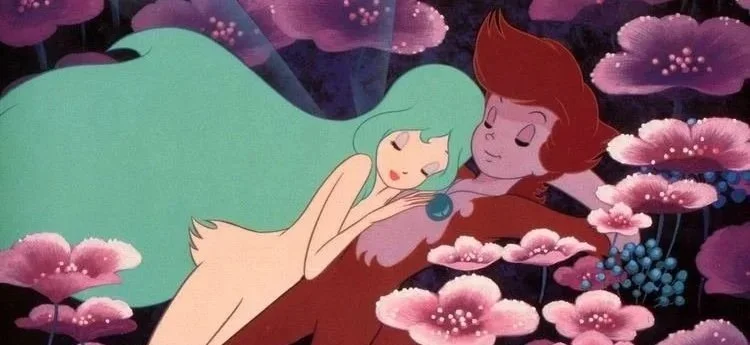
The Sea Prince and the Fire Child adapts Romeo and Juliet into an elemental romance between water and fire, reframing forbidden love as a clash between incompatible forces of nature. Yet its power lies just as much in the beauty of its animation as in its story. The narrative closes on an ambiguous note, presumably shaped to soften the experience for young audiences, while unintentionally producing one of the most iconic endings to this classic tragic romance.
-
Directed by Tim Burton.
“That was the single most thrilling experience of my entire life.”
Perched high above a pastel suburb, an unfinished creation descends into a world eager to admire what it cannot understand. Beneath its whimsical charm lies a bittersweet fairy tale where love, wonder, and suspicion exist in equal measure, revealing how quickly fascination can become fear. Edward Scissorhands reminds us that those who bring the most beauty into the world are often the ones it struggles hardest to embrace.
This is the only film in Burton’s catalog where he was involved in all three major creative roles—story, directing, and producing—which is likely why Edward Scissorhands feels like his best and purest artistic expression.
-
Directed by Kevin Reynolds.
“He doesn't have a name, so death can't find him.” — Enola
One of cinema’s most fascinating cult epics, drifting between survival and salvation. Its infamous budget and oceanic chaos gave it a reputation, but beneath that surface lies a visionary piece of world-building. What’s unforgettable about Waterworld isn’t just the spectacle—it’s the mythology of it all. A lone drifter cursed with gills, a child carrying a map to dry land tattooed on her back, entire communities surviving on floating scraps of civilization. It feels like a folktale told after the flood, a cinematic myth set adrift on the open sea.
-
Written and Directed by James Cameron. Starring Leonardo DiCaprio and Kate Winslet.
“Paint me like one of your French girls.” — Rose Dawson
There are films, and then there is Titanic—the epic that solidified my love for romantic tragedy and became a cultural imprint of the 90’s. A ballroom frozen in time, the gold and velvet of first class set against the grit of the boiler rooms, with Jack and Rose carving out a fleeting eternity in the midst of it all. We know the ending, and yet every watch pulls us under all over again.
-
Directed and Written by P.J. Hogan. Written in Collaboration with Michael Goldenberg.
"They'll sweetly drown you if you get too close." — Peter Pan
This is the most achingly beautiful retelling of Peter Pan, the kind of tale that lingers in the heart of every girl who ever grew up too soon by losing someone to Neverland. It captures the wonder of believing in faeries and the ache of having a childhood sweetheart you are destined to outgrow. More than an adaptation, it feels like a memory—fragile, fleeting, unforgettable.
-
Directed by Gore Verbinski.
"But you have heard of me." — Captain Jack Sparrow
Adventure, romance, and myth entwine in the original Pirates of the Caribbean trilogy—Curse of the Black Pearl (2003), Dead Man’s Chest (2006), At World’s End (2007)—a saga conjuring something eternal: skeletons by moonlight, an epic love-triangle, a sea goddess imprisoned in mortal form, the organist of an underwater vessel, a heart locked in a box. There is no film I’ve seen more on the silver screen than At World’s End, visiting it over and over again with my father shortly before his passing. It will always feel like ours.
If Disney had been wise, they would have left Jack Sparrow at three (with his love-triangle) instead of continuing to produce diminishing sequels—and given us the prequel we’d all been longing for: the tempestuous love story of Calypso and Davy Jones, a tale with the heart to rival the trilogy itself.
-
Directed by Nick Cassavetes. Based on the Novel by Nicholas Sparks.
“If you’re a bird, I’m a bird.” — Noah Calhoun
Their love feels both impossible and inevitable. Noah is the dream every woman secretly writes into her diary: the boy who reads your love story back to you when you can no longer remember, builds the house you described, writes you love letters, and rows you through a swan lake (the birds that mate for life). It’s devotion made flesh, lingering like a promise, the kind you’d swear could only be written by a woman—yet astonishingly, was written by a man.
-
Written and Directed by Christopher Nolan. Produced by Christopher Nolan, and his wife, Emma Thomas.
"The dream has become their reality. Who are you to say otherwise?" — Inception
What begins as science fiction becomes something stranger and more seductive: the idea that dreams can be built, infiltrated, rewritten. Streets bend skyward, staircases loop into infinity, and reality itself feels porous. Beneath it all lies a love story that collapses under the weight of obsession, echoing like a refrain through every layer of dream. A romance about the unbearable weight of not letting go—the spinning top a reminder that sometimes the most powerful love is the one you must release.
-
Written and Directed by Mike Cahill. Produced by Mike Cahill, Hunter Gray, and Alex Orlovsky.
“When the big bang happened, all the atoms in the universe, they were all smashed together into one little dot that exploded outward. So my atoms and your atoms were certainly together then, and, who knows, probably smashed together several times in the last 13.7 billion years. So my atoms have known your atoms and they've always known your atoms. My atoms have always loved your atoms.” — Ian Gray
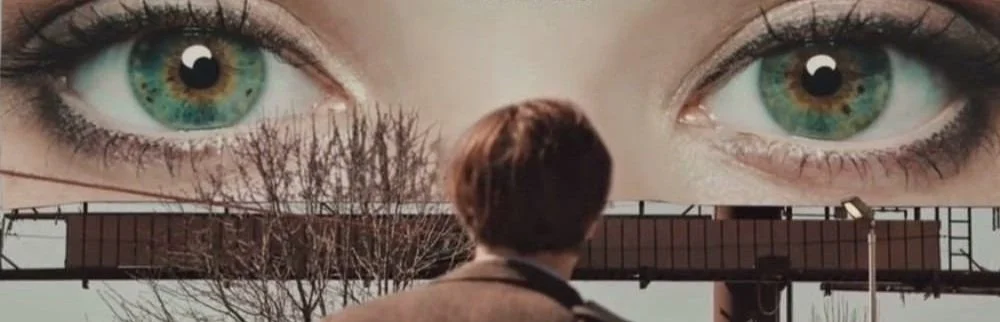
No film has ever struck me the way I Origins did the first time I saw it. Enhanced by a psychedelic, the film became a prophetic vision—eyes like constellations, whites that glowed instead of burned, every image heightened into a visual feast. My past life lover drifted to sleep beside me, which felt like its own kind of metaphor—but I was wide awake, entranced. What stayed with me was more than the beauty: the possibility of iris patterns spanning lifetimes, reincarnation traced in the eyes, the windows to the soul betraying the persistence of love across lifetimes.
-
Written and Directed by Anna Biller. Cinematography by M. David Mullen.
"The day he left me was the day I died. But then I was reborn... as a witch!" — The Love Witch
The Love Witch is a lush and deadly fever dream, moving through men’s lives like a prophecy, enchanting with shades of technicolor, lavish sets, and a sense of heightened reality. The story charms with its twists and excesses, but the true reason it belongs on this list is the seed it planted, which grew into the aesthetic of my first feature film script.
-
Directed by Lee Daniels. Written by Suzan-Lori Parks. Based on a Book by Johann Hari.
“My song, Strange Fruit. It reminds them that they're killing us.” — Billie Holiday
This is the portrait of a woman who sang freedom into being, even as it consumed her like Strange Fruit. What endures is not only the music, but the terror of how far America went to silence it. Her voice becomes both weapon and wound—cracking, burning, fragile yet unbreakable—carrying truth through melodies the state tried to bury. And in the end, it is not tragedy alone, but the unshakable fact that Holiday’s art outlives her persecutors, echoing long after their power has turned to dust.
southern trees bear a strange fruit
blood on the leaves and blood at the root
black bodies swingin' in the southern breeze
strange fruit hangin' from the poplar trees
pastoral scene of the gallant south
the bulgin' eyes and the twisted mouth
scent of magnolias sweet and fresh
then the sudden smell of burnin' flesh
here is a fruit for the crows to pluck
for the rain to gather
for the wind to suck
for the sun to rot
for the tree to drop
here is a strange and bitter crop— Strange Fruit, Billie Holiday
-
Directed by Jeff Zimbalist and Maria Bukhonina. Starring Angela Nikolau and Ivan Beerkus.
"Our full potential is on the other side of fear." — Angela Nikolau
A meditation on risk, devotion, and the thin line between freedom and falling, Skywalkers: A Love Story follows two urban climbers who turn the world’s tallest structures into their stage. Suspended between steel and sky, their relationship unfolds at the same vertiginous height as their craft — where trust is not poetic, but literal. The film is less about spectacle than about the quiet psychology of those drawn upward: the discipline behind the dare, the intimacy forged in shared danger, and the strange calm found above the noise of the world. What could read as recklessness becomes something more vulnerable — a portrait of two people building love in a place where one misstep could end everything.
-
Directed and Written by Zoë Kravitz.
"There is no forgiveness. There's just forgetting."
On a secluded island reserved for the unimaginably wealthy, time dissolves into endless parties and perfect days, until subtle cracks begin to emerge. Glamour gives way to manipulation, memory becomes unreliable, and every beautiful surface conceals another violation. Beneath its intoxicating façade, Blink Twice explores the terrifying relationship between privilege, predation, and the corruption of memory.
-
Directed and Written by Ti West.
“I will not accept a life I do not deserve.”
— Maxine and the PreacherWhat begins as a slasher becomes something far more intoxicating: a love letter to Hollywood's relentless hunger. Fame, desire, and reinvention collide in a world where every spotlight casts an equally unforgiving shadow. Beneath the blood-soaked glamour lies a woman determined to become a star—even if she has to survive the nightmare that built her.
Understudies
-
Directed by Bernard Vorhaus with Cinematography by John Alton.
“Do you think I’d make a good celestial companion?” — The Spiritualist
A glimmering séance in chiaroscuro, this film noir feels like it escaped the pages of Painting with Light—the first cinematography book inked by a master of the art. The Spiritualist (also known as The Amazing Mr. X) is a study in visual seduction and spectral glamour, where every twist flickers like candlelight. Watch now.
-
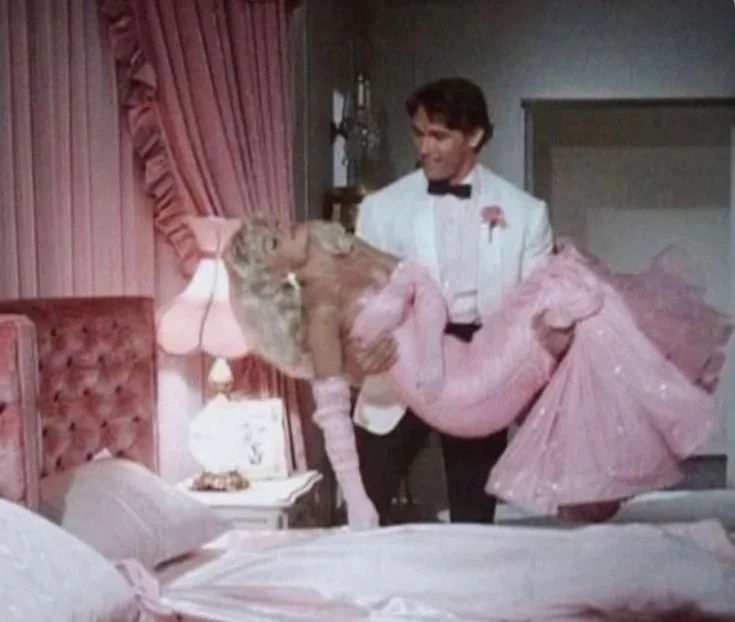
Starring Arnold Schwarzenegger and Loni Anderson.
Listed in The 100 Most Enjoyably Bad Movies Ever Made by The Golden Raspberry Awards.From the iconic scene that has turned into the ultimate meme for princess treatment to the tragic final act, this film is a Classic Hollywood fairytale. Beneath the platinum hair and tabloid sparkle, the film captures Jayne’s relentless pursuit of her dreams and her grace in balancing it all with motherhood. It’s a portrait of feminine ambition, masculine devotion, and loving heartbreak—glittering with the kind of Hollywood magic that can only end in myth.
The only way to watch this film without commercial breaks is through out-of-print DVD or vintage VHS. -
At first it feels like a teenage cliché—the bad boy, the preacher’s daughter—but slowly it becomes something luminous. By the time Jamie is framed in her light blue dress, asking Landon to build her a telescope, the film has already transcended romance and become a meditation on the fragile beauty of miracles.
-
A hymn to isolation and survival, Where the Crawdads Sing weaves mystery into the reeds of the marshland. The tale of the Marsh Girl is both a murder mystery and a love letter to the natural world, its Southern Gothic heroine—shaped by abandonment—finding her voice in the rhythms of nature. By the end, what seemed like a tragedy becomes an ode to the fierce intelligence of a woman who belonged to no one but the wild.
“Wuthering Heights” (2026)
The Whip and the Body (1963)
Valerie and Her Week of Wonders (1970)
Sunset Boulevard (1950)
The Vampire Happening (1975)
Suspira (1977)
Contact (1997)
Eternal Sunshine of the Spotless Mind (2004)
Pan’s Labyrinth (2006)
Life of Pi (2012)
The Great Gatsby (2013)
Frankenstein (2025)
The Ugly Stepsister (2025)
El Cadáver de Anna Fritz (2015)
Adoration (2019)
Portrait of a Lady on Fire (2019)
Disney
Mortals
Alice in Wonderland (1951)
Peter Pan (1953)
Sleeping Beauty (1959)
The Little Mermaid (1989)
Aladdin (1992)
Pocahontas (1995)
Hercules (1997)
Mulan (1998)
Tarzan (1999)
Animals
Bambi (1942)
The Lady and the Tramp (1955)
The Aristocats (1970)
The Fox and the Hound (1981)
The Lion King (1994)
