
Ariadne
Sculpture by Laurent Delvaux
Channeled by a Taurus Sun, whose soul resonates with the enduring presence of the Goddess—guiding us through the labyrinth of history.
What if the myth of Ariadne — the Cretan princess who helped Theseus slay the Minotaur, only to be abandoned and later deified — wasn’t just a story of love and betrayal, but a symbolic encoding of humanity’s spiritual and cultural transformation across the ages?
Using the astrological ages as a mythic blueprint, we can trace how the divine feminine — once central in human consciousness — was veiled, wounded, forgotten, and is now rising again. From the lush temples of Crete to the labyrinthine depths of the subconscious, from bull cults to sky gods, from Ariadne to Mary — this is the goddess’s journey through time.

Ariadne by Asher Brown Durand (1800’s)
The Age of Taurus: The Embrace of the Goddess
(c. 4000–2000 BC)
Long ago, in the Age of Taurus, the world was cradled in the arms of the Great Goddess. Her presence was felt in every seed sown, every harvest reaped, and every life nurtured. Societies flourished under her guidance, celebrating fertility, abundance, and the sacredness of life. Scholars such as Dr. Heide Goettner-Abendroth in The Goddess and Her Heroes speak of this age — matriarchal cultures and societies shaped by seasonal rhythms, fertility rites, and the knowledge that life moves in spirals, not lines. Where the feminine was not merely revered, but the origin.
She was the land, the life-giver, the labyrinth.
But then something changed…

Theseus and Ariadne, painting by Antoinette Béfort, Salon of 1812 and 1814.
The Age of Aries:
The Rise of the Hero and the Labyrinth of Forgetting
(c. 2000 BC – 1 AD)
As the stars shifted and the Age of Aries dawned, a new narrative emerged. The heroes rose, their swords gleaming, seeking glory and dominion. The harmonious balance began to tilt. The Goddess, once at the center, was now hidden, her stories twisted into labyrinthine tales.
The Age of Aries dawned around 2000 BC—and with it the masculine rose in fire. The rising warrior-kings of Assyria, Greece, and Rome turned worship into conquest. They were no longer content to serve the Goddess — they wanted to possess her.
To overwrite her stories with their own.
It was in this crucible of change that the myth of Ariadne was born.
She is a mystery. A thread. A trace.
Ariadne, theorized to be a title of the Great Goddess in Crete, becomes disguised as a mortal princess in her tale. (Originating around 2000–1350 BC). She helps Theseus kill the Minotaur — the massive, uncontrollable goddess-bull of the Age of Taurus — and is then abandoned by the hero she saves.
But let’s unravel this...
In this tale lies the encoded trauma of a spiritual shift: the goddess grows monstrous, her wisdom reduced to puzzle and imprisonment, her power hidden within the spirals of a story she authored to hide.
The Age of Aries rises with epics and empire — Achilles, Gilgamesh, Moses — stories of sacrifice and domination. The divine becomes masculine. Kings become gods. And the Goddess?
She is either forgotten, demonized, or rewritten.
In the oldest tales, which the Great Goddess had written herself, Dionysus finds Ariadne (halfway along her journey) upon the island of Naxos — after being abandoned by Perseus: a masculine figure which would have succumb to the bull without her.
Recognizing her divinity, Dionysus elevates her to the stars as the constellation Corona Borealis.
This act symbolizes the resurrection and deification of the feminine principle by the divine masculine: the conscious marrying the subconscious.
Dionysus, a god of divine ecstasy and resurrection, foreshadowed Jesus: the Age of Pisces DM figure that the Goddess conceived to usher in the new age of the Christian Era.

Lioness of Christ: Ariadne riding the Lion of Judah.
“Some Christian traditions associate lions with Christ's conception and resurrection, drawing parallels between the lion's mythical "stillborn cubs" to the immaculate conception and resurrection of Jesus Christ.”
The Age of Pisces: The Veiled Goddess of Virginity
(c. 1 AD – 2025 AD)
With the birth of Jesus around 1 AD, the Age of Pisces began, emphasizing compassion, sacrifice, and spiritual union. The parallels between Dionysus and Jesus are striking: both are associated with wine, death, and rebirth. Both are divine sons. Both suffer. Both die and rise again. Both speak of love, ecstasy, wine, and spiritual truth that defy worldly order.
And behind each of them stands a woman:
Ariadne — once abandoned — is found again by Dionysus, who crowns her immortal.
Mother Mary — the Virgin, the Queen of Heaven — rises from obscurity to become the Mother of God.
Ariadne (eh·ree·ad·nee).
Mother Mary (muh·thr meh·ree).
Four syllables each.
A rhyme in rhythm — open, closed, open, closed.
Both carried by the vowel-sound of awe.

Ariadne of Naxos by Ernst Stern (1912) dressed in Mother Mary blue.
What if the Great Goddess of Crete did not vanish, but simply changed veils?
What if Ariadne survived by hiding herself in the sacred mysteries, emerging again in the tender arms of the Piscean age — this time as a Mother Goddess so pure she could only be divine?
Pisces gave the world the gift of devotional love — a healing balm after the rage and war of Aries. It gave men a masculine ideal in Joseph, the quiet protector of Mary — a man not of conquest — but of sacrifice, compassion, and unity.
Yet Pisces is also the age of illusion, martyrdom, and spiritual control. The Goddess is adored... but still silent. Still distant.
Now, the waters break.
We are at the threshold of a new age.

The Three Graces at the Place De La Bourse. Bordeaux, France.
The Age of Aquarius: The Goddess Returns to Pour out the Waters of the Subconscious onto the Lands of theWorld
(c. 2025–4000 AD)
The Age of Aquarius begins now — with Pluto making its final crossing this year, never to return to the sign before it. The old structures are behind us. The waters ahead, uncharted.
Spiritual Axis of Our Age
Leo — Aquarius
Autocracy — Autonomy
Aquarius is ruled by Uranus — Ouranos, known as the god of the heavens and father of Aphrodite. Just as his daughter, the goddess of love and beauty, was born from the severance of his masculinity as it fell into the ocean, the Age of Aquarius may also birth beauty through the gathering sea foam of its water-bearing.
The rebel Prometheus is often linked as another masculine archetype of Uranus and Aquarius., known as the titan who stole fire from the gods to give to humanity. What unites these two masculine archetypes is their profound sacrifice: yet through their suffering, they bore fire, sustenance, beauty, innovation, and even love itself.
Above us, the moon’s of Uranus turn in a slow, deliberate dance. It has been illuminated to me that most of them are named after women. Heaven, itself, is calling back its daughters.
If we shift our gaze to the Galactic Center — and the wisdom of the Vedas — we see the feminine archetype of this new age in the sign of Shravana, ruled by the goddess Saraswati and positioned at 3° Aquarius. As the goddess of wisdom, learning, music, and the arts. Saraswati is no mother of empires, she is the current through which culture itself is rewritten.
Saraswati follows the same phonetic rhythm of Ariadne and Mother Mary—or even Kalyn Lady.
She is the Great Goddess ascending the throne of the World in the new age.
Following The Thread
What if Ariadne was never lost or abandoned, but the architect of the labyrinth — both its weaver and the keeper of its map?
Perhaps the Goddess became the labyrinth itself, hiding her wisdom until we were ready to seek it again. She has changed her name through time — from Ariadne to Mother Mary to Saraswati — but her guidance remains, ready to lead us out of forgetting and into the spiral of a new story.
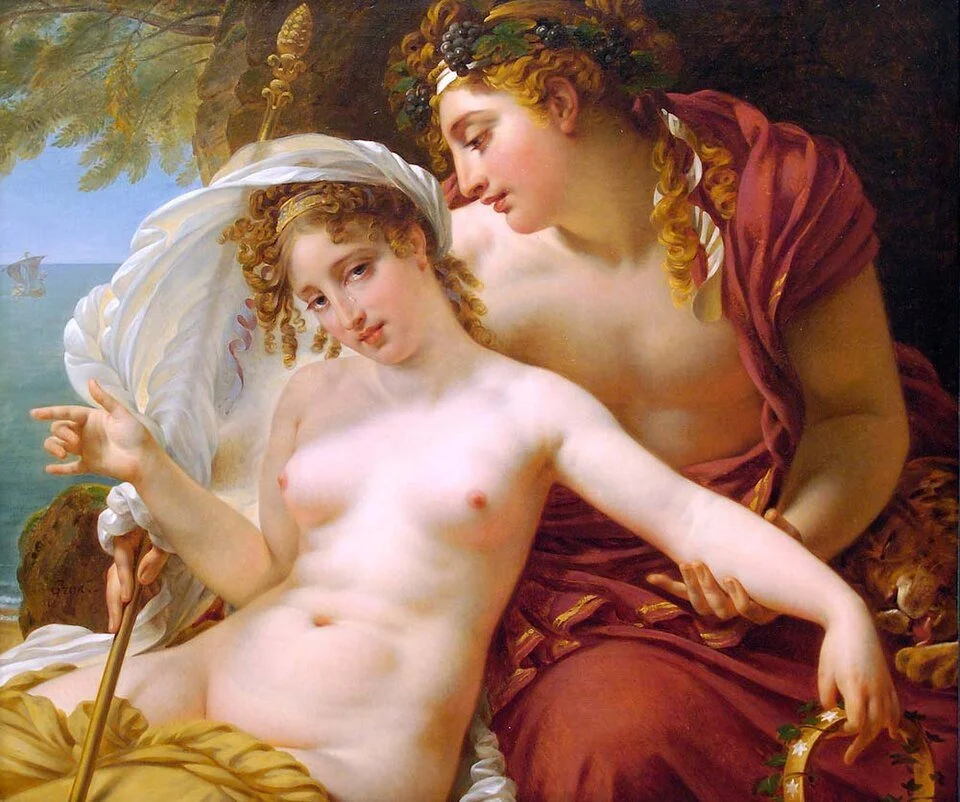
Bacchus and Ariadne by Antoine Jean Gros


Channeled by a Taurus Sun, whose soul resonates with the enduring presence of the Goddess—guiding us through the labyrinth of time.